


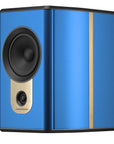


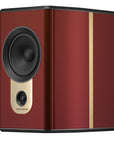


Meet the all-new Figaro! An evolution of our most successful speaker series. Five years have passed since the original Figaro was introduced in 2018 and yet we are pushing the limits once again. The new Figaro is vastly improved in all aspects. Embrace a new modern design with brass metal accents and satin color options. We give you a remarkable tandem of performance and design where science meets art.
Figaro! Designed to be easily driven by most amplifiers and with the ability to be placed very close to the wall. Figaro's task is to make your life easier with as simple as possible setup, cable, and amplifier matching. We wish you many great moments while listening to your Figaro.
Two-way speaker system designed with Mini-Horn loaded silk dome tweeter and our unique midbass driver which works in extended mid-band effectively making it an Extended-Band driver, allowing us to push crossover frequencies of the drivers further away from the most critical area for the human ear - 1000-1500Hz and thus reduce crossover distortions and perception of them. Two whole new re-designed ER (Extra Rigid) hard paper cone bass drivers deliver faster and deeper bass response and improve overall sound clarity.
The Cabinet-In-a-Cabinet enclosure system taken from upper scale Virtuoso series contributes to a complex closed system that eliminates unwanted resonances by turning acoustical energy into heat, allowing all drivers to perform with precision and dynamics.
Figaro features outriggers with height-adjustable spikes, WBT NextGen connection terminals with bi-amping for models L and XL, and also a whole new 6 unique never seen before satin finishes with brass metal accents.
Dimensions (HxWxD) : 337mm x 223mm x 339mm; 13.27 x 8.78 x 13.35in
Weight : 10 kg/22 lbs each
Shipping weight : 12 kg/26.4 lbs each
Sensitivity : 89.5 dB @ 2.83V 1m
Suggested amp power : 5-150 W;
Impedance : nominal 4,0 ohms;
Crossover frequency : 4000 Hz
Frequency response (in-room environment) : 42-25000 Hz
Drivers : 19mm silk dome tweeter, 15.2cm ER paper cone mid-bass driver
Figaro utilizes a Mini-Horn loading technology to cope with the infamous soft domes problem - cone breakup and cone "walk". Cone breakup and "walk" happens when a soft dome tweeter is being driven hard at high signal levels. Distortions rise exponentially because:
a) when a certain point in signal level and thus dome acceleration/amplitude is reached, the center part of the dome flexes in an uncontrolled fashion due to the silk's soft nature
b) differences in air pressure behind the dome and in front of the dome creates a nonlinear environment and overcome suspension ability to prevent axial movement of the cone
Our Mini-Horn is based on acoustical dampening which happens at the frontal dome area. We carefully measure at which frequencies the dome starts to flex and emit an avalanche of distortions. Mini-Horn then is designed and manufactured according to desired specifications to dampen those frequencies. The result is a proportional dampening of the tweeters’ movement. The louder it plays the more dampening and air pressure on the frontal area it gets from its own emitted sound. It is described as acoustical impedance and is highly dependent on the Mini-Horn's shape. Another positive by-product of this process is that Mini-Horn adds sensitivity and thus the efficiency of the driver.
The human ear has uneven sensitivity to different frequencies. We are naturally less sensitive to high frequencies and especially to low frequencies. The exception is sensitivity to mid frequencies in the 1000-2000Hz band due to evolution. Simply put - in nature, the sounds of life-threatening events lie more or less in 1000-2000Hz diapason, so naturally, we are most sensitive to that so we could stay alert. The downside of this phenomenon in this rather safe modern world is that we can hear and pinpoint the slightest imperfections in reproduced sound at those frequencies. And imperfections in sound reproduction are called distortions.
Most of the manufacturers calculate crossover points in exactly this area of 1000-2000Hz. Since each driver has its natural spectrum of distortions we actually can hear the transition from one driver to another, let alone an additional distortions caused by the crossover phase shift. The resulting sound is described as an unnatural or multi-way sound. It is not possible to completely eliminate natural-born driver's distortions or the phase shift in crossover which is mathematically tied to how db/oct crossover is calculated. The only way to fight this is to utilize crossover points away from this region of 1-2kHz. For that reason, we created an Extended Band Midrange driver. Crossover points of 400-4000Hz are one octave away from the sensitive band. Not only this solution helps with crossover distortion perception but the listener gets uniform, unchopped sound coming from one driver with virtually zero phase shift. Homogenous sound in our opinion is one of the biggest goals in the audio industry.
The new Figaro! speakers share a Cabinet-In-a-Cabinet enclosure design. This system is based on two separate enclosures - an inner cabinet and an outer cabinet bonded together by a thin layer of Polyurethane. The inner cabinet is manufactured of a lightweight yet rigid material that controls primary vibrations by absorbing acoustical power coming from the drivers. Then a thin layer of viscous Polyurethane situated in between the inner and outer cabinets acts as a dampening layer which converts vibrations born in the inner cabinet to heat. The residue of vibrations is then dampened by the outer cabinet which is manufactured of a much heavier and less dense material that acts as a mass damper.
Second generation Figaro speaker utilizes re-designed bass drivers with ER paper cones. Er stands for Extra Rigid paper. It is actually visible on the cone surface as flakes of hard pulp and fibers and is natural to rigid cones. ER paper cones were chosen due to all the pros of traditional paper cones and the pros of hard material cones. Hard cones (metal, ceramic, etc.) provide uniform push-pull movement where all cone's points act as a uniform piston which is desirable. Con is that hard cones have the potential to have early break-up points and ringing due to a lack of dampening properties inside the material itself. Paper on the other hand does not have break-up points as it is quite soft and flexible but it does not act as a piston, and usually, the edge of the paper cone are fluttering, and all cone is flexing. Having positive properties of paper and introducing hardening materials like sturdy fibers and hard pulp gives us a unique cone that acts as a piston, but at the same time does not have ringing or early cone breakup points. ER cones allowed us to introduce new piston-like bass drivers and of course our Extended Band Midrange.
Hi-Fi Advice review and an award.
Ayon Scorpio III and AudioSolutions Figaro B2


Switching back and forth between the two systems reveals a “saddled” frequency curve in the Ayon/AudioSolutions system, with a dip in the 250-500 Hz range. Such a frequency curve may deviate from utter neutrality, but it generally sounds very pleasant. I’d wager this is actually a big advantage in smaller rooms where the speakers have to be placed close to the walls. This friendly curve aside, the sound is open, extended, and hugely infectious for its upbeat timing and delightful expression. I must admit that it is hard to stop listening to this Ayon/AudioSolutions system. It simply never fails to make my foot tap and put a smile on my face.
The bass quality is impressive for a speaker of this size, reaching low notes down to 42 Hz. Of course, they do not sound as powerful in the bass as the Magicos or an average floor-standing speaker. But the bass they produce is of very good quality, and that always matters more than quantity. Notably, presumably in part because the speakers have been carefully tuned to allow for placement near walls, they possess delightfully clean, linear, and well-behaved bass when placed freely. Although moderately sized, the designers have resisted making the speakers appear larger than they are by over-using the bass-reflex port. Unlike some small monitors, there is no bass bump, booming, or muddiness—just clean, well-articulated bass with good body and weight. My main listening area is 5 meters wide and 7 meters deep, with large open spaces on the sides, yet these monitors never felt small to me. They do not sound underpowered, either! The Figaro B2s are easy to drive and can play loudly without any strain.
The more I listen to this system, the more I realize what makes these speakers special. One might expect a very clean and controlled sound from bi-walled speakers, and in a way, they do deliver these qualities. However, they do so in a fluid, effortless, and remarkably musical way.
As I relaxed into the performance, I recalled being impressed with the first version of the Scorpio when I reviewed it with the Spirit III. After the review, I still had particularly warm feelings for the Scorpio. Still, I kept the Spirit III, predominantly for its higher power and increased control, which I tend to need with most speakers I use. There was a tradeoff, though, in that the Spirit could be relatively less refined, while the Scorpio was always effortlessly fluid, musical, and emotionally appealing.
I have a similar feeling today with the Scorpio III and the AudioSolutions B2 speakers. This combo sounds so effortlessly musical and liquid that it makes me want to relax into the music as I play album after album. It can be challenging to compare two products that are separated by years and belong to different systems, yet I still recognize all the qualities I noted in the Scorpio III. Furthermore, I have a strong impression that the Scorpio III is more neutral, lively, and expressive than the original.
4-Ohm or 8-Ohm
As Ayon mentions in the manual, there are no rules for matching the speakers to the 4-Ohm or 8-Ohm connections, and there is technically no danger of a mismatch. It is recommended to try both and go with what sounds best.
With rare exceptions, I generally prefer to use the 8-Ohm connections for their livelier presentation. Of course, this still ties in with the speaker and personal preferences, but with the AudioSolutions Figaro B2, too, I preferred the 8-Ohm outputs. The 4-Ohm outputs provide a slightly thicker, arguably more relaxed and intimate presentation, but at the cost of a measure of directness and expression.
Triode Mode
With the Scorpio, swapping between Pentode and Triode mode must be done with the amplifier switched off. After switching off, the amplifier performs an extensive tube check procedure, makes bias adjustments, and indicates any faults on the rear panel display upon power on. This process takes a few minutes but provides peace of mind.
I’ve previously compared the two modes with Ayon and other amplifiers and generally preferred the Pentode mode for its crisper and livelier presentation. The Triode mode typically provides a lusher, more romantic sound with less well-defined and often rolled-off frequency extremes. Still, the increased intimacy can be worth the tradeoff.
Because the amp sounded superb from the start of Penthode mode, I did not try the Triode mode, but it is nevertheless great to have the option.

Amp Swap
A cross-comparison with the Bryston Bi-200 integrated amplifier confirms my impressions of the Ayon Scorpio III and the AudioSolutions B2 speakers. First, this comparison indicates that the Scorpio III sounds admirably neutral and linear. Second, the speakers maintain their exceptional quality of being clean and controlled yet effortlessly fluid. Also, the “saddled” curve is still present. However, the loss of tube magic is now quite evident. Sure, as one might expect, the Bryston is even more neutral, provides more control, and is considerably more powerful. It is a testament to the brand that it masterfully retains a pleasant smoothness and avoids the sound becoming cool, clean, or analytical in the face of its neutrality, power, and control. Nevertheless, there is no substitute for tubes when looking for ultimate liquidity, lushness, and midrange magic.

The situation is similar when using the Accuphase E-270 integrated amplifier. Like the Bryston, it is a transistor design, and unlike some of the brand’s higher-tier models, the E-270 does not try to hide its transistor nature. Incidentally, while the brand’s bigger models, as well as the E-280, provide more bloom and smoothness than the E-270, they still do not perform as beguilingly liquidly as the Scorpio. As tube fans already know, there’s just something special about them. The beauty of the Ayon is that it provides these tube-typical qualities without allowing the areas where tubes are typically less well-endowed from spoiling the party.
USB input
I hesitated to try the Scorpio’s USB input, thinking it might be an afterthought. However, I’m glad I did, as it performs surprisingly well! Equipped with an Amanero USB receiver, the built-in DAC delivers a robust, lively, open, and engaging sound. While it might be expected that the built-in DAC would not match the performance of the Aqua La Diva M2 CD transport paired with the CH Precision C1.2 DAC that I used as a reference, the differences are more minor than I anticipated, primarily concerning refinement and delicacy. Typically, a CD transport possesses a uniquely lively yet “free-flowing” quality that music servers find challenging to replicate. In this case, though, the innate juiciness and fluidity of the Ayon/AudioSolutions combination make the differences seem less significant. The built-in DAC maintained its propulsive and communicative sound even when I used a simple homemade music server. The built-in DAC is far from an afterthought; significantly improving upon the built-in DAC would require investing about as much as the amplifier itself costs.
Conclusion
The AudioSolutions Figaro B2 speakers paired with the Ayon Audio Scorpio III create an affordable system that works exceptionally well together, delivering a fluid, spacious, and engaging sound that encourages long listening sessions.