


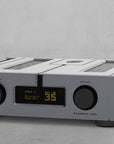
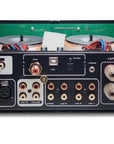


CLASSIC 102i integrated amplifier
CLASSIC 102i is designed to further enhance the sound reproduction of our previous integrated amplifiers.
We have no hesitation in stating that we have entered a new era of low-noise and high harmonic contrast
circuits. This has been made possible by a new circuit design, a modern volume control system, state-ofthe-art components, and a range of advanced features that guarantee crystal-clear and precise sound.
One of the main features of CLASSIC 102i is its ability to amplify the audio signal without distortion and with a high dynamic range. The sound is reproduced with the utmost fidelity, without background noise,
alterations in frequency response, and the typical distortion that limits the dynamic sense of music.
Additionally, 102i is equipped with a variety of audio inputs and outputs, making it compatible with a wide range of devices. An exceptional MM phono input, a balanced input, and 3 line inputs make it possible to use this modern electronics with any source, from CD players to turntables.
The optional DAC with Hyperstream technology implemented on SABRE ESS 9038 q2m further expands the connectivity possibilities for digital and streaming enjoyment with an unparalleled level of reproduction.
Finally, we have also designed it to be easy to use and configure. Thanks to its simple and intuitive interface, you can set it up in minutes and start enjoying high-quality sound in an intuitive and fast manner.

Balanced and dual mono circuitry
In the new 102i we have substantially increased the power of the power supply stage and we have developed the entire project with a dual mono philosophy. Each channel of the preamplifier has separate and excellently filtered and stabilized power supplies, as well as the entire ground planes.
This allows for extremely effective channel separation which translates into a very natural sound, with incredible and realistic focus and stage reconstruction. Each instrument remains well focused in space and the powerful power section promotes unprecedented dynamics.
The wiring reduced to a minimum, the conversion of the line inputs to balanced and the possibility of equipping the integrated amplifier with a high-performance DAC, which can always be updated in the future, guarantee absolute and immutable performance over time.
The entire project is completed by a high-performance RIAA PHONO section for lovers of vinyl records and the possibility of using the PRE-OUT / AMP-IN outputs selectable by remote control for unprecedented versatility.
The balanced circuitry. It's our philosophy, and we take pride in developing it to its fullest potential, always have.
There are quite a few conflicting opinions on this configuration. Some claim it's pointless for home use, thers argue it degrades and muddies the sound, while some say it's merely a ploy to drive up the cost of equipment for purely commercial purposes.
To some extent, all of this could be true only if this aspect of the design is neglected or poorly executed.
Recent technical tests in the field have also shown that if the overall design is executed properly, the end result can be considered the pinnacle in terms of musicality, transparency, and dynamics.
In the CLASSIC 102i, nothing has been left to chance, starting from a dual mono power supply and circuitry, all the way to the very heart where each amplification section is duplicated. This includes the innovative volume control, which employs two separate stages for each channel on an array of digitally controlled
MOSFETs. Furthermore, thanks to its native balanced nature, even single-ended line inputs are fully converted to balanced, including the RIAA PHONO stage. In very simple terms, you won't find a more d ynamic and transparent preamplifier than this.
The balanced circuitry. It's our philosophy, and we take pride in developing it to its fullest potential, always have.

The volume control section, a stage not to be underestimated.
The most delicate, fundamental part and to be treated with extreme care, because it is also this stage that overall determines the general performance of reproduction.
Unlike many manufacturers who use classic motorized potentiometers, we have developed a completely different stage which guarantees the project a set of very important performance advantages. We have implemented gain control via an array of armored Mos fets in a special IC which are controlled digitally. As a first factor, we have forever eliminated the wear of the carbon layer typical of traditional potentiometers and this forever eliminates the onset of the annoying Hum & Noise and Pop & Click that are inevitable with wear over time.
Another advantage that is often overlooked is the linearity of the response which is modified as the volume increases or decreases with the use of carbon layer potentiometers or even the more sophisticated resistor array potentiometers.
This happens when a resistance is found in the signal passing through the potentiometer which also modifies the impedance factor and which causes this artefact. The balanced circuitry. It's our philosophy, and we take pride in developing it to its fullest potential, always have. There are quite a few conflicting opinions on this configuration. Some claim it's pointless for home use, others argue it degrades and muddies the sound, while some say it's merely a ploy to drive up the cost of equipment for purely commercial purposes.
To some extent, all of this could be true only if this aspect of the design is neglected or poorly executed.
Recent technical tests in the field have also shown that if the overall design is executed properly, the end result can be considered the pinnacle in terms of musicality, transparency, and dynamics. In the CLASSIC 102i, nothing has been left to chance, starting from a dual mono power supply and circuitry, all the way to the very heart where each amplification section is duplicated. This includes the innovative volume control, which employs two separate stages for each channel on an array of digitally controlled MOSFETs. Furthermore, thanks to its native balanced nature, even single-ended line inputs are fully converted to balanced, including the RIAA PHONO stage. In very simple terms, you won't find a more dynamic and transparent preamplifier than this.
Thanks to our technology, however, this problem has been definitively eliminated because the signal does not see a resistance that varies as the knob changes but rather a network of mos-fet devices that act directly on the feedback of a high impedance and high bandwidth operational amplifier.
The optional DAC section:
it is possible to equip the preamplifier with a latest generation DAC stage which further expands the 102i's inputs for new digital technologies. 3 additional inputs USB, COAX and OPTICAL make the amplifier extremely versatile with a wide choice of connection options to best enjoy your music from your favorite source. Whether it is usable from streaming, from a CD player or from the television, with this section you will get the best in terms of reproduction and musicality.

The DAC reads files with conversion up to 384 Khz in PCM and DSD 256 in Dop or DSD 512 natively. Installation is very simple and the firmware automatically recognizes the DAC connection, enabling the appropriate controls and service menu section on the display..
www.eamlab.com
Made in Italy
Native balanced dual mono integrated amplifier
• RMS power per channel, both channels driven @1Khz
1. 100W @ 8 ohms
2. 180W @ 4 ohms
3. 290W @ 2 ohms
• EIA power per channel, both channels driven / 20hz-20Khz.
1. 190W @ 8 ohms
2. 300W @ 4 ohms
3. 450W @ 2 ohms
• THD + N – A-weighted - 0.003% at full power into 8 ohms
• Inputs
1. 1 balanced input via XLR
2. 3 line inputs
3. 1 RIAA MM phono input
4. 1 selectable AMP-IN input
• exits
1. 1 pair of RCA PRE-OUT
2. 1 pair of 6mm Binding posts
• Input impedance:
1. 47 Kohm via XLR, 22 Kohm via RCA
• Slew/rate
1. 35 V/uS
• Frequency response
1. From 20 Hz to 40 Khz +/- 0.2 dB
• Phono input
1. MM – 47Khom – 41 db gain
• DAC section
1. USB – 384 Khz pcm – DSD256 in Dop mode / native DSD 512
2. COAX
3. Optical
• Channel separation > 77 db
• A-weighted SNR >102 db
• Dimensions: 38 ––x 42 x 11 cm. (D x W x H)
• Weight: 15 kg
• OPTIONAL DISPLAY COLORS
White, yellow, green, blue
Remote control included
Classic 102i
USER MANUAL
Thank you for purchasing this product.
EAM Lab has always been dedicated to creating top-quality,
state-of-the-art audio components.
Our technicians are committed to rigorous quality control to
ensure the highest construction standards and reliability.
This philosophy applies to every step of the manufacturing
process, from research and design to final testing, to provide
a reliable product that satisfies listeners in every use.
Welcome to EAM Lab, a group of music enthusiasts and true
sound lovers.
This device is subject to mains voltage. To avoid the risk of electric
shock, do not open the cover, expose it to moisture or rain, or attempt
to make modifications or repairs. Seek assistance only from certified
and qualified personnel.
Safety Information:
1. To achieve optimal performance, carefully read this manual. Keep it in a
safe place for future reference.
2. Install the unit in a cool, dry, and clean location away from windows,
heat sources, intense vibrations, dust, moisture, cold, and buzzing
sources (transformers, motors, etc.). To prevent the risk of fire or
electric shock, do not expose the unit to water and moisture.
3. Never open the equipment. If something enters inside, contact your
dealer.
4. Do not use switches and other controls with force. When moving the
unit, first disconnect the power cord and cables connected to other
devices. Never pull the wires themselves. NOTE: The cover openings
provide adequate ventilation for the unit. If these openings are
obstructed, the temperature inside rises rapidly. Therefore, install the
unit in a well-ventilated location, avoiding placing various objects in
front of these openings to prevent damage. Leave at least 5 cm of
space behind, 5 cm on both sides, and 5 cm above the top panel of the
machine to avoid sudden overheating.
5. The voltage used must be as specified. Using this product with a
current whose voltage is higher than specified is dangerous and can
cause damage. EAM LAB is not responsible for any damage due to
improper use of the equipment.
Specification Sheet:
1. INPUT: 1 stereo XLR balanced, 4 stereo RCA single ended
2. POWER: RMS each channel driver 100/180 W Rms 8/4 ohm
3. XLR INPUT IMPEDANCE: (xlr input) 47 Kohm
4. RCA INPUT IMPEDANCE: (input2/3/4)22 Kohm
5. FREQUENCY RESPONSE: 10 hz to 80 Khz +/- 1 db
40Khz to 150Khz +/- 1 db
6. VOLUME CONTROL: in digital domain
THD: 0.003% full power @ 8ohm
7. SIGNAL NOISE RATIO: >99 Db
8. IDLE CURRENT: 1 A @ 230Vac
9. DIMENSIONS: 420 x 380 x 100 (WxDxH) mm
10. WEIGHT: 15Kg
Remote Control:
FUNCTIONS
1. PWR - power on/off
2. DSP - not used
3. V+ / V- - encrease/decrease
volume
4. MUTE - mute outputs
5. CH+ / CH- - select sources
6. SET - configurations menu
BATTERY REPLACEMENT
Only use CR 2032 model batteries.
To replace, remove the 4 screws on the bottom side of the remote
control. The battery is on the bottom of the circuit board. Ensure
correct polarity.
The remote control transmits a directional infrared beam. During
operation, ensure to point the remote towards the sensor.
If the sensor is covered and obstructed by large objects, it will not
receive the signal. The sensor may not be able to properly receive
signals when exposed to direct sunlight or strong artificial light.
! If the remote control only works when close to the unit, the
batteries are running low. Replace them with new batteries.
Display
Functions:
You access the functions menu via the SET button on the remote
control.
BALANCE - Channel balance adjustment (right and left)
DB Attenuation - Output volume control
DAC Setting - D/A filter slope and their roll-off adjustment
SET Exit - from the submenu
Components:
1. SPEAKERS
2. RCA INPUT
3. REC OUTPUT
4. COAXIAL INPUT
5. USB INPUT
6. XLR INPUT
7. selectable by remote
8. OPTICAL INPUT
9. AMP IN - PRE OUT
10. POWER SWITCH
11. GROUND
12. POWER SOCKET
Troubleshooting:
1. Problem - No power on
Possible Cause - The plug on the power cord is not connected or is not fully inserted. The mains fuse is blown.
Remedy - Securely connect the plug or check the fuse on the rear panel next to the socket.
2. Problem - No sound
Possible Cause - Connecting signal input or output cables incorrectly.
Remedy - Check the RCA or XLR cables and/or the correct connection sequence of sources.
3. Problem - Distorted sound
Possible Cause - The source has an output signal too high and the preamplifier input is saturated.
Remedy - Turn down the volume of the source if it is equipped with such control.
4. Problem - The signal is low
Possible Cause - Switch XLR/RCA on power amplifier.
Remedy - Check the correct position of the switch for connecting balanced XLR or unbalanced RCA.
5. Problem - Main fuse is blown
Possible Cause - Current overload.
Remedy - Replace with an identical fuse. If the fuse blows again, contact the service center.
6. Problem - Remote control does not work
Possible Cause - Batteries, objects in front of the receiver.
Remedy - Replace batteries or remove any obstacles in front of the infrared receiver.